TL;DR
In a home with no pets, no allergy sufferers, and average runtime, change a 15x25x1 air filter every 90 days. One pet or mild allergies pulls that to 60 days, and multiple shedding pets, asthma, or heavy runtime pulls it to 30 or 45. A one-inch filter holds very little dust, so the calendar only reminds you to look.
Key Takeaways
• 90 days is the ceiling for a one-inch filter, not the standard.
• Runtime matters more than calendar days, so peak season shortens every interval.
• The factors stack down to the shortest that applies. They do not average.
• One pet: 60 days. Multiple pets or asthma: 30 to 45 days.
• A filter that still looks clean at 90 days may be bypassed. Check the grille frame for a gray outline.
• Count your return grilles. A forgotten second filter undoes the schedule on the first.
• 15x25x1 is nominal. The real cut is about 14.5 by 24.5 inches. Order from the label, not the tape.
• The gap between a 90-day and a 30-day schedule is eight filters a year.
The Short Answer, and What It Leaves Out
Ninety days is the outer limit for a 15x25x1 under easy conditions, not a schedule to coast to. ENERGY STAR’s heating and cooling guidance asks homeowners to check monthly in heavy-use seasons and change at minimum every three months, making it a ceiling on inaction rather than a target.
It assumes no pets, nobody managing allergies or asthma, 8 to 12 hours of daily runtime, and no renovation dust in the returns. Change one and the number moves. Most homes I walk into have changed two.
What Determines How Long a 15x25x1 Filter Lasts
A filter does not expire on a date. It fills up, and six things fill it faster than the label suggests.
• Blower runtime. The largest variable, and the one nobody tracks. A system running 16 hours a day through an Alabama July moves twice the air of one running 8 hours in spring, so count seasons, not months.
• Pets. Dander and hair load a filter faster than anything else. One short-haired cat is mild. Two golden retrievers is another schedule.
• Allergies and asthma. A loaded filter still traps particles, but airflow drops and less air gets cleaned each hour. If symptoms persist despite a tight schedule, the cause may be growth on the coil, which is where pairing filter replacement with UV light installation helps.
• Filter efficiency (MERV). Denser MERV 11 and 13 media catches more fine particulate, so it loads faster than MERV 8 in the same house. If your filter carries an FPR number, this breakdown of how Filter Performance Rating compares to MERV lines the two scales up.
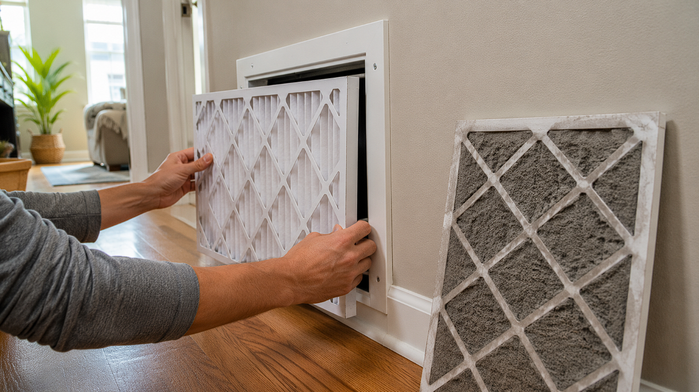
• Filter fit. A filter that does not seal gets bypassed, and bypassed air never loads the media, so it still looks clean at 90 days. When I pull a suspiciously white filter, I check the grille frame for a gray shadow, which is dust that went around it.
• The house itself. Carpet, an unsealed crawlspace, leaky return ducts pulling attic air, construction, wildfire smoke, or a gravel driveway shorten it.
Real Timelines by Household
Find the profile closest to yours, then let the filter confirm.
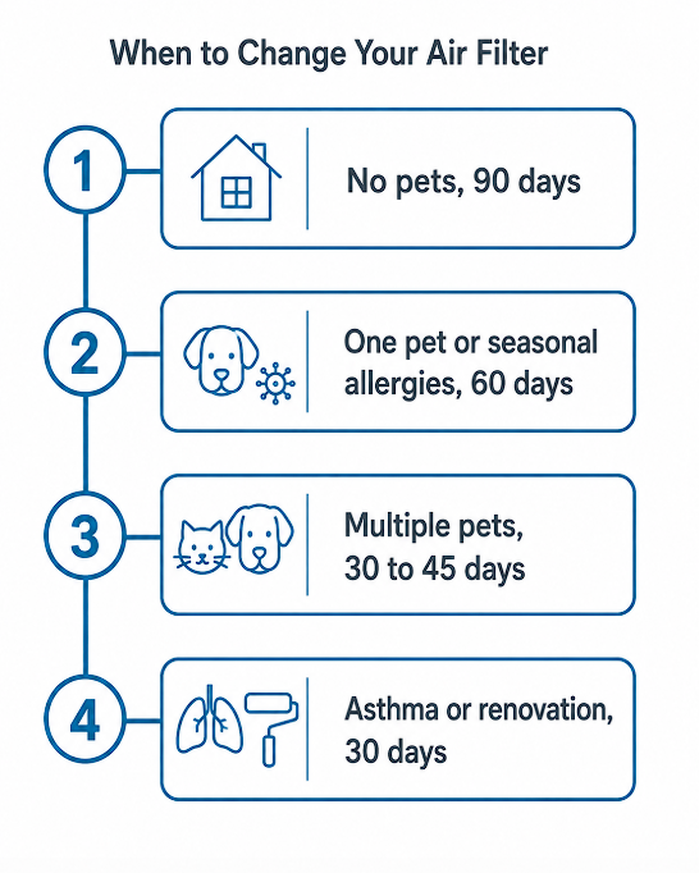
• No pets, no allergies, average runtime: 90 days
• One pet or seasonal allergies: 60 days
• Two or more shedding pets: 30 to 45 days
• Asthma or year-round allergies: 30 to 45 days
• Peak cooling or heating season: 45 to 60 days
• Renovation, drywall, or heavy wildfire smoke: 2 to 4 weeks
• Seasonal or lightly occupied home: up to 120 days
Most homes match more than one line, so two rules help. The factors stack down to the shortest that applies rather than averaging, putting a house with two dogs, MERV 13, and an August load on the tightest. And set the interval by season, because almost every home I service is two houses: 45 days June through September, 90 days otherwise.
How to Tell Your Filter Is Done Without Guessing
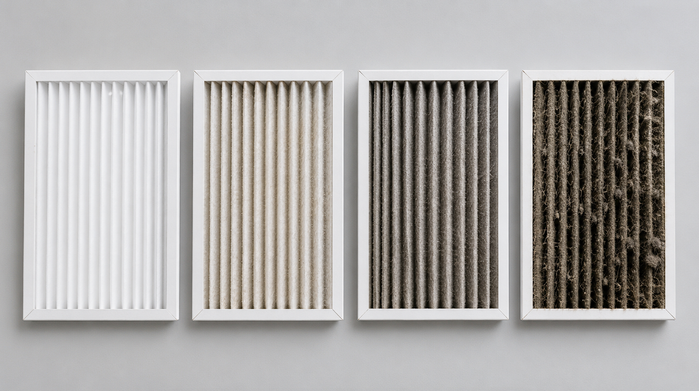
Two checks settle it in under a minute. Hold the filter up to a bright light, and once you cannot see light between the pleats, replace it whatever the date says. Then watch the system, because weaker register output, longer run cycles, or a unit that never catches up on a hot afternoon all point back to a restricted filter. If you are unsure where the filter lives, this walkthrough of where the AC air filter is positioned in a house covers the ones people miss.
Before you trust any interval, including the ones here, run one calibration cycle. Put in a fresh filter, write the date on the frame, and pull it at exactly 30 days. Barely discolored means you can stretch toward 60 or 90. Closed pleats mean a 30-day cycle. Homeowners tend to overestimate by about a month, and almost nobody guesses too short.
Count Your Returns Before You Trust Any Schedule
Count your return grilles, because many homes have more than one and a forgotten second filter undoes the schedule you keep on the first. Two-story houses usually have two, as does almost any house with an addition, and the second sits where nobody looks: a hallway ceiling, behind an open door, a closet.
I find heavily loaded filters in those several times a month, in houses where the hallway filter has been changed on time for years. Filtration ends up worse than the calendar suggests, and the neglected filter raises static pressure on the same blower. Walk the house with a flashlight, mark every grille, note the sizes, and change them together.
Why One-Inch Filters Load Faster Than Thicker Ones
Depth is capacity, and a 15x25x1 does not have much. It carries roughly a quarter of the media surface area of a four-inch filter in the same nominal size, so it loads far sooner. One-inch slots are what most return grilles and older air handlers accept, so the format trades interval for fit. Pleating buys back some capacity, which is why a properly sized pleated filter outperforms a flat panel on both counts.
One detail here deserves more attention than it gets. 15x25x1 is a nominal label rather than the actual cut, and the real filter measures about 14.5 by 24.5 by 0.75 inches. Because it is uncommon, shelves rarely stock it, and I have lost count of the homes where someone forced a 16x25x1 into the slot. The filter buckles, the seal breaks, and unfiltered air takes the gap.
The second version of that mistake catches the careful homeowners. Measure your old filter with a tape instead of reading the label and you get 14.5 by 24.5, sold as its own product line. Filterbuy catalogs 14.5x24.5x1 and 15x25x1 as separate products, and the one your system takes is printed on the filter you pulled. Order from the label, not the tape. With no label, measure the slot and round up.
The exact dimension matters more than a higher MERV rating, and this is where ordering online beats a hardware run. A shelf carries the sizes that turn over fastest, while a manufacturer cutting to order has no such limit, which is why Filterbuy lists more than 600 U.S.-made sizes. 15x25x1 filters are available in MERV 8, 11, and 13 with the actual cut on the spec.
One caution runs against the usual advice. Higher MERV is not automatically better on an older system, because denser MERV 13 media can push static pressure past what an undersized return duct and blower can handle. Step up a rating, then back down if airflow weakens. A MERV 8 changed on time beats a MERV 13 starving the blower.
What the Shorter Interval Costs, and How to Stay Stocked
The arithmetic behind a shorter interval is smaller than most people expect. Ninety days is four filters a year, 60 days is six, 30 days is twelve, so the gap between loosest and tightest is eight filters. Price the one you buy, multiply by eight, and for most households it lands near a single dinner out.
The harder part is supply. A 30-day cadence only works if a filter is in the house on day 30, and this is not a size you can count on locally. What I run into is the gap month, where the old filter comes out and the system runs empty until the replacement lands. Do not do that. Without a filter, the coil and blower wheel become the filter, and cleaning either costs more than a year of filters.
Keep the next two or three on a shelf and buy the year in one order, since per-filter pricing drops sharply by quantity. The Filterbuy 15x25x1 tiers are steep enough to change that arithmetic before you talk yourself into a longer interval. Then write 15x25x1 on the grille frame in marker.
The Question Behind the Question
What I say most often when homeowners ask me directly:
“The 90-day number is not wrong. It is answering a different question than the one homeowners are asking. They want to know when their filter is done. Ninety days tells them when the manufacturer stops guaranteeing it. Those are not the same date, and in a house with two dogs they are not even the same month. Pull it at thirty days once. The filter will tell you the truth faster than I can.”
What Stretching the Interval Actually Costs
A loaded filter restricts airflow, and that raises static pressure across the system. It shows up as longer run times, higher energy use, and in cooling season a risk of the coil icing over. The EPA’s Inside Story: A Guide to Indoor Air Quality advises following the manufacturer’s filter schedule, or changing every month or two when none is given. Every frozen coil I have thawed started with somebody saving fifteen dollars.
Essential Resources: What to Verify Before You Buy Your Next 15x25x1 Filter
Seven sources on efficiency, dimensions, and timing:
1. Confirm the Actual Dimensions Before You Order
Filterbuy, 15x25x1 Air Filters · https://filterbuy.com/air-filters/15x25x1/
Lists the actual cut, 14.50 by 24.50 by 0.75 inches, alongside MERV 8, 11, and 13.
2. Choose Between MERV 8, 11, and 13 Using a Neutral Source
EPA, What Is a MERV Rating? · https://www.epa.gov/indoor-air-quality-iaq/what-merv-rating
Capture efficiency for every rating from 1 to 16, by particle size, from a neutral source.
3. Understand Why a Loose Filter Defeats a Good One
EPA, Guide to Air Cleaners in the Home · https://www.epa.gov/indoor-air-quality-iaq/guide-air-cleaners-home
Confirms filters must fit snugly so air does not leak around them, and explains that FPR and MPR are proprietary while MERV is not.
4. See What a Clogged Filter Costs in Energy and Equipment
U.S. Department of Energy, Maintaining Your Air Conditioner · https://www.energy.gov/energysaver/maintaining-your-air-conditioner
Replacing a dirty filter can lower an air conditioner’s energy use by 5 to 15 percent, and when airflow is obstructed, dirt bypasses the filter and settles on the coil.
5. Set the Interval for an Allergy or Asthma Household
Asthma and Allergy Foundation of America, Healthier Home · https://aafa.org/allergies/prevent-allergies/healthier-home-indoor-air-quality/
Indoor air can be two to five times more polluted than outdoor air, and AAFA’s home checklist puts filter replacement among the core indoor-trigger controls.
6. Decode the FPR Number on Your Current Filter
AC UV Light Installation, Enhance HVAC Performance With FPR · https://www.ac-uv-light-installation.com/enhance-hvac-performance-with-filter-performance-rating-fpr
Explains that FPR is retailer-specific rather than an industry standard.
7. Find Your Filter Before the 30-Day Inspection
AC UV Light Installation, Where Is the AC Air Filter Positioned in My House? · https://www.ac-uv-light-installation.com/solving-the-puzzle-where-is-the-ac-air-filter-positioned-in-my-house-
Covers return grilles, air handlers, wall units, and ceiling slots.
Supporting Statistics
Two federal findings sit behind the intervals above.
1. More Than 90 Percent of U.S. Homes Carry Three or More Allergens
NIH and NIEHS, “Allergens widespread in largest study of U.S. homes” (2017, NHANES 2005 to 2006)
https://www.nih.gov/news-events/news-releases/allergens-widespread-largest-study-us-homes
In nearly 7,000 U.S. homes, more than 90 percent of bedrooms held three or more detectable allergens, and 73 percent held one at high concentration.
2. Pet Allergens Reach Nearly Every Home, Including Homes Without Pets
NIEHS, Pet Allergens
https://www.niehs.nih.gov/health/topics/agents/allergens/pets
More than half of U.S. households keep a dog or cat, and their allergens turn up in almost every home, including pet-free ones, because particles travel on clothing.
Next Steps
Pull your filter today and hold it up to the light. If you cannot see through the pleats, replace it now, write the date on the new frame, and set a 30-day reminder. That inspection will tell you your real interval better than any guideline, this one included. Then buy two at a time so the next change never waits on a shipping window.
Frequently Asked Questions
Is 90 days too long for a 15x25x1 filter?
In a home with pets, allergy sufferers, or heavy runtime, yes. Those households belong at 30 to 60 days. In a low-dust, pet-free home it is fine.
Can I vacuum or wash a 15x25x1 pleated filter to extend it?
No. Disposable pleated media relies on an electrostatic charge and a fiber structure that degrade when wet or agitated, and vacuuming pushes particles deeper.
My filter is a little gray at 30 days. Should I be worried?
Not at all. Light, even discoloration at 30 days is a filter doing its job, and a lightly loaded filter catches fine particles slightly better than a new one.
Can I run the system with no filter while I wait on a delivery?
Avoid it. The dust lands on the coil and blower wheel instead, and both cost far more to clean than a filter.
Glossary
15x25x1 Air Filter. A nominal HVAC filter size commonly used in return grilles and air handlers. In this article, the actual filter dimensions are approximately 14.5 x 24.5 x 0.75 inches.
MERV. Minimum Efficiency Reporting Value, a rating used to describe an air filter’s ability to capture particles. The article discusses 15x25x1 filters in MERV 8, MERV 11, and MERV 13.
Nominal Size. The rounded size printed on an air filter label and used when ordering a replacement. A nominal 15x25x1 filter may have smaller actual dimensions.
Pleated Filter. An air filter with folded filter media that provides more surface area for capturing airborne particles than a flat-panel filter.
Return Grille. A grille where indoor air is drawn back into the HVAC system. Some return grilles contain air filters and a home may have more than one filtered return.
Learn more about HVAC Care from one of our HVAC solutions branches…
Filterbuy HVAC Solutions - West Palm Beach FL
1655 Palm Beach Lakes Blvd., Ste 1005 West Palm Beach, FL 33401
(561) 448-3760